Automotive Innovation – The First Online Owner’s Center

Early online services such as Prodigy, Compuserve and AOL broke new ground, finding new ways to engage with their subscribers. In the 1990’s the automotive industry took a leap of faith and jumped in on the action. There were services like Autobytel, one of the first online buying services. Major manufacturers also participated, including Toyota. 

In the early days, it was possible to work directly with the manufacturer and bypass their advertising agency. This was the case with Toyota, and I was fortunate enough to work with Jim Pisz, who was a direct response manager at the company. He was (and still is) a visionary. Like the clueless salesperson I was, I went in trying to sell him advertising to Prodigy’s 1 million subscribers. He was smart enough to ask a pivotal question: “How many Toyota owners are among those subscribers??” Followed by, “Can we create an owner’s center for our own customers?”

After several trips to Toyota’s office in Torrance, California and several white board sessions later, the outline for the owner’s center fell into place. It would include product information, racing information from TRD (Toyota Racing Division), owners services and a bulletin board.

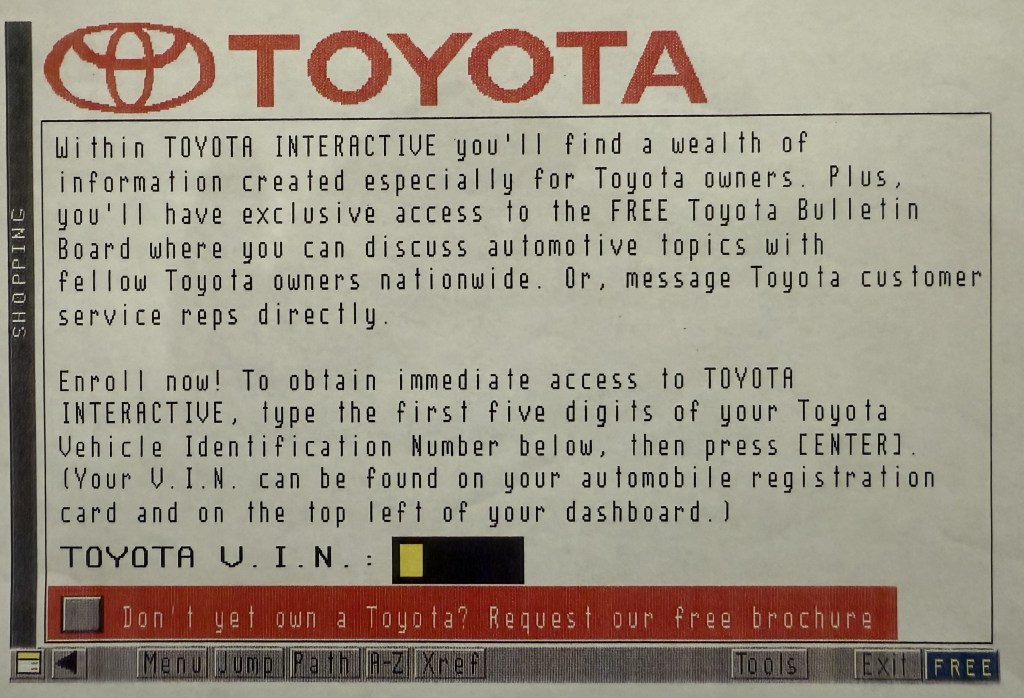
Manifesting the audience online relied on some basic direct response techniques. Prodigy subscribers were matched against Toyota ownership records. This was a classic merge and purge with a resulting tape (yes, tape) of Toyota owners on Prodigy. A Prodigy email was sent to those members,  inviting them to the Toyota owner’s center where they could begin using the service without registering. New owners who came on the service entered their VIN, which would automatically register them to use the service.

We learned a lot from the project. The fundamentals of direct marketing still applied, even in this “cutting edge” new medium.  Owners loved being in more direct contact with the Toyota and their correspondence reflected that enthusiasm. Bulletin boards were a two edged sword – when you asked what consumers thought about the Toyota product you got the good, the bad and the ugly. Something we see 30+ years later in social media.

Below is the home screen for the Toyota application on Prodigy, circa 1994.

…and the registration screen, for new Toyota owners who started using Prodigy for the first time.

Ma’am, the Online Grocery Order is in Your Broom Closet

Many years ago I started working as part of a team that implemented online grocery stores. This was for one of the early online services Prodigy (pre-internet), which was based out of White Plains, New York.

When we traveled to demonstrate the service, we did so with 2 huge anvil cases – one for the monitor one for the CPU. So large they had to be checked under the plane. These cases would literally come tumbling off the conveyer belt in the baggage claim area. When we did get to the grocer, we had to hunt down a phone line that could handle the 2400 baud modem. Sometimes it was in a meeting room, once it was on the loading dock at Publix corporate headquarters.

One of our clients was Dominick’s in the Chicago area, with about 20 of their stores participating in the online delivery service. This was very cutting edge at that time, and yet they made the commitment. Each store had their own PC and printer, so orders placed by consumers could be downloaded, printed, then picked and packed, staged for delivery to the customer or available for pickup.

At times, it was clear that we were asking a lot of our clients. For example, at one point we received a call in White Plains from one of the Chicagoland grocery locations. Their customers were complaining about not receiving their Prodigy grocery order. The ensuing conversation went something like this:

Grocer: “Hey Prodigy customer service, we are getting complaints that customers didn’t receive their grocery order from your service”

Prodigy: “Ma’am, you need to go to the Prodigy computer in your store and print out the order”.

Grocer: “Where is the Prodigy computer?”

Prodigy: “We don’t know where it was placed at your store, can you look?”

Grocer: “Oh, my manager set that up, but he’s not in the store today. Give me a few minutes”

Grocer: “OK! We found the Prodigy computer. It’s in the broom closet. What do I do now?”

Prodigy: “Let me walk you through the steps of finding, and printing the orders……”

There were several misconceptions about online grocery in those years. Among them:

  • Convenience will outweigh selection. Wrong! The initial thought was that a smaller subset of grocery items would be “good enough” for online shoppers But, online grocery shoppers expected exactly the same products online that they did in-store. And they let us know it.
  • Convenience will outweigh quality. Wrong! If an item that was picked, packed and delivered wasn’t EXACTLY what the consumer expected, credit was due.
  • The economics were challenging. If it took someone at the store 45 minutes to pick and pack an order, and they were being paid union wages, it would eat into the slim (2%) retail profit margin.
  • The technology had to catch up to consumer behavior. It might take someone 1 hour to place an online order, only to have the online service disconnected at the 59th minute!  Thus, “save and restore” was born.

Early adopters included Grocery Express, Dominics, Schnucks, King Soopers, D’Agostino, Kroger and others.

I think of what a leap of faith the early grocery adopters took every time I get a Fresh Direct order today.

I make sure to leave a nice tip.

The X Factor: How Legacy Institutions Impact Innovation

If our media business was based only on taking the most efficient path, programmatic buying and selling would stand alone as the ONLY option, and direct buying and selling would have already disappeared. While no-one can dispute the outsized impact of programmatic, direct buying and selling still persists. The more original and well branded a publisher’s content is, the more likely that direct selling is predominant, with programmatic as an option.

Now, I’m not here to debate the merits of one over another. What I do want to introduce is the outsized impact on legacy institutions – Agencies and Publishers – in impacting the adoption of this technology. And, I believe, you could say the same about any business sector.

Agencies have long provided guidance in media buying to their clients, weighing product, audience, creative and media choices to improve the standing of those clients in the marketplace. In return, publishers and media owners have built their own staff to respond by matching quality content and ad exposure to provide results for agencies and their clients. While programmatic has whittled away at this legacy, it will take years before it replaces the legacy institutions now in place.

Another example of legacy institutions slowing things down is the buying, selling and operational management of advertising across streaming platforms AND broadcast (linear). There are actually order management platforms that can handle both media channels, as well as standard digital display. You would think in the interest of efficiency, that consolidation be commonplace by now. However, in many cases media planning and buying are conducted by two different Agency divisions, and the trafficking and delivery process is different for streaming versus linear on the publisher side. So operational consolidation remains a potential that is still being held back for legacy institutions.

This opens up a broader discussion. How will legacy institutions impact other technical innovations? Will original thought and individual voices go away tomorrow because AI is a “thing” today? Certainly, it is going to have an outsized impact, but it will be more gradual than we believe. Will banks and the existing financial infrastructure go away overnight because cryptocurrency is a “thing” today? No.

This is only to say that in calculating the impact of new technology, consider the legacy institutions that are in place and the impact THEY will have on moderating the adoption rate, which will most likely take place over a longer period of time than it’s advocates predict.

If it has not been done already, it might be an interesting exercise to turn it into a mathematical calculation when considering the potential upside of any new technology. If that has already been done, please let me know.

(No AI was used in the composition of this post)

Is That Your Voice, or is it AI?

Stating the obvious, AI will be a tremendous benefit to several sectors of industry from manufacturing and quality control to medical diagnosis and cures. No matter what you do, it’s probably a benefit in at least creating a starting point for research.

Less than obvious is how we personally use AI to manage our daily communication.

In the arts, whether it is music, acting, writing, you frequently hear the phrase “find your voice”. Meaning, or course, to let your personality, your knowledge and your emotions show in your creative output.

I have been the recipient of several documents authored by AI. I can tell that is the case, because I am missing the distinct voice of the author. And the details and research skim the surface of the topic or cover superficial research that is not really relevant to the topic. I know, I know, it is dependent on asking AI the right questions. But still, the “voice” is what I miss.

A colleague of mine subjected one of my posts to AI – asking to write it in different voices. Honestly, it was scary how good it was. But it was not me. Maybe my writing is not concise enough. Maybe my phrasing is awkward at times. But it is my voice, which like all of our voices, is distinct.

So I am wondering, do you think you will use AI for personal business communication? Or will you use your own voice?

(No AI was used in the composition of this post)

Walter Edward Deming’s Impact on Order Management in Media.

Walter Deming’s legacy had an enormous impact on manufacturing, and I’d argue, on media operations. In 1950’s post-war Japan he preached the importance of process and workflow in improving manufacturing excellence. He is recognized as the key influence in transforming the Japenese economy into a model for quality – think Toyota. In fact, Japan created the “Deming Prize” awarded to those who have impacted quality control in manufacturing.

 And what does that have to do with order management in media?

Among other things, Demings preached the importance of having a full knowledge of the end to end process in creating anything. And this is particularly important in our media business, because it’s complexity encompasses multiple platforms, from CRM to OMS, DMP, Ad Serving, Billing and Data Management. Understanding these “links in a chain” is a never-ending pursuit.

Demings advocated for the “appreciation of a system” including, among other things:

Understanding the overall processes involving suppliers, producers and customers.

Understanding how interactions between elements of a system and the rules that govern them force the system to behave as a single organism.

Think of this as workflow being a series of links in a chain.

Personally, I found Deming’s thought process inspiring early in my career. It helped in viewing ad operations wholistically from quote to cash, as the phrase goes.

I’d recommend looking at “Out of the Crisis” in which Deming elaborated on his theory of management and quality control, and detailed that in his “System of Profound Knowledge” – gotta love that understatement, right? Also, “Demings Journey to Profound Knowledge” by John Willis is also very good – listening to that as an audio book at the moment. (No AI was used in the composition of this post)

I’m going to use the “D” word.

I have a theory about those of us who work on the operations side of the media business. We are fixated on the details and determined to get things done to the exclusion of all else. This means that no matter what your background, executing tasks is the primary objective and all else falls away.

Over the last couple of years, I’ve sat in meetings with men and woman from the U.S., Europe, UK, Middle East, India and Mexico. Sometimes, every one of those countries is represented in a single meeting. And it is the execution of the tasks that binds them all together in a common purpose. Professionalism and pride have no geographic boundaries.

Even in the most conservative media companies, I find operations professionals from an extraordinary cross section of geography, ethnicity, and gender identification. Again, nobody cares as long as shit gets done.

This reminds me of a specific incident. I was working onsite, space was limited, and I shared a cube with an internal technical lead. We swiveled our chairs to face each other and had a chat. At some moment in the conversation, we both realized we were polar opposites in terms of political beliefs. We looked at each other, shrugged, and turned our attention, collaboratively, back to the project.

This is why I love this part of the media business that is at the intersection of technology and human interaction: Diversity. There. I said it.

(AI was NOT used in the composition of this post)

Against All Odds

On March 1, 2021, The McClatchy Company, a newspaper publisher founded in 1857, accomplished something remarkable. Despite a pandemic, financial restructuring, a sagging economy, and social upheaval, they made a radical transformation in sales and advertising operations. They accomplished this in just 7 months, across 30 markets, launching on time and with no disruption in operations. As a result, McClatchy set the stage to save millions of dollars a year.

This type of project is challenging in the best of times. How did McClatchy accomplish it in the worst of times? What made this a success despite the odds? What lessons can we take from this?

REPLACING A FRAGMENTED INFRASTRUCTURE

Over the course of several years, McClatchy had created a sales and advertising operations infrastructure that required the engagement and coordination of 9 vendors. The company was highly dependent on development resources to create custom solutions to make all these applications work together. Separate order management systems were required to support print and digital. There was no integration with the digital production system Google Ad Manager. All of this contributed to a fragmented infrastructure that was inefficient and expensive.

WHAT LED MCCLATCHY TO CHANGE?

McClatchy was motivated to change out of necessity. First, creating and supporting custom solutions led to an increasing level of complexity and cost that was not sustainable. Second, the challenges of supporting a network of newspapers and preserving professional journalism are well documented and like many companies, McClatchy was in search of solutions that could make an impact. Finally, the fragmented state of applications supporting the advertising and operations business needed to be centralized and vendor solutions existed that would meet this need.

MANAGEMENT’S MANDATE

Once the project received the “green light” McClatchy’s management team helped set the stage for success, making it clear that this project was one of the company’s highest priorities. Launching on March 1 was a necessity, not an option. There were significant financial consequences for NOT hitting the date which helped drive urgency. Management stressed the need to produce a solution that supported the business, while avoiding the complexity and customization that led to the problems in the first place.  They gave full autonomy and authority to the Project Manager, enabling them to make key decisions in real time, avoiding the need for a prolonged process of decision by committee.

This type of management support and messaging is critical to the success of projects that span all business units in a company. Without it, you may have a small group of dedicated individuals driving a project, without a corresponding sense of urgency from the rest of the company. Unless all parties are pulling oars in the same direction, the project will flounder. McClatchy made sure that did NOT happen.

VENDOR SOLUTIONS

The search for vendors to support this transformation began with an exacting RFP process. McClatchy’s business requirements were documented. Vendors were explicitly asked “Do you support this requirement today, or not? If it is not supported today, when do you expect it to be available to the publisher?” McClatchy knew what they were getting as well as any feature gaps that needed to be addressed. As the evaluation process came to a close, references were checked, interviews with other publishers were conducted, providing an added degree of confidence in the selections.

Lineup was selected to support sales and advertising operations. They supplied a platform that enabled McClatchy to consolidate the functions of several applications at launch. This includes CRM (replacing Salesforce), digital order management, print display management, general classified management, accounts receivable and invoicing functions. Soon, additional consolidation will be achieved by supporting pre-print (insert) functionality in Lineup, followed by support for programmatic.

IntegrationX was selected to support pagination layout. One of their key benefits was their existing integration with Lineup and with the downstream print production vendor CUE. With this selection, McClatchy was able to avoid costly and protracted custom integration work. And it allowed them to keep their focus on configuring the 30 publications that relied on these systems. 

In addition to technology, both vendors brought strong teams to the project. The Lineup account team was comprised of individuals who had detailed knowledge of the product, supported by deep and relevant industry experience. They went “above and beyond” as partners. Without this level of support and expertise, the deployment would not have succeeded.

Similarly, the IntegrationX team were subject matter experts in their field of pagination and layout in support of print. Quick to find solutions to problems, they were instrumental in insuring that on launch day, 30 publishers went to press without any interruption in production and distribution to customers.

PROJECT MANAGEMENT

DMW MediaWorks ran the vendor review and selection process, vendor onboarding, project management, post-launch support and development. As mentioned, key to success here was management’s decision to place the responsibility for decision making squarely on the shoulders of the project manager. A team of 7 McClatchy stakeholders were designated covering the functions of CRM, ad products, workflow, digital and print integrations, business intelligence and finance. Bi-weekly meetings covered deliverables for the project as well as any risks and mitigation required to make course corrections. As the project reached the “final mile”, daily scrums were held to address issues in real time. The DMW team of two subject matter experts, had a collective 50 years of experience in managing projects focused on sales and advertising operations. Proving that it is not the number of people thrown at a project that determines its success, but whether they are the right people.

THE PEOPLE AT MCCLATCHY

The “X” factor in the success of this project were the people at McClatchy. It is not easy to pivot from being heavily invested in legacy applications (both financially and emotionally) – to embracing a brand-new platform. It is not easy to remain motivated in the face of a pandemic AND remote work AND corporate restructuring, AND social unrest. And yet, the people at McClatchy embraced the change, remained motivated and exhibited the highest degree of professionalism. Absolutely remarkable given the range of challenges. And this is the “X” factor in the project. All the elements mentioned above could have been in place, but without the dedication and contribution of the entire staff at McClatchy, March 1 would have come and gone without achieving McClatchy’s goals.  

SUMMARIZING THE “SECRET SAUCE”

For those readers who prefer a shorthand version as opposed to a narrative, here is a summary of the keys to success for this project

  • The vendors were evaluated based on their ability to support specific business requirements
  • Maximum consolidation was the goal, while at the same time minimizing the number of vendors and custom development
  • A common, centralized catalog of ad products was created, which served all publishers.
  • Corporate management provided clear direction and a mandate that the project was priority #1 and that failure was not an option
  • Accountability and authority to make decisions was placed squarely on the shoulders of the Project Manager, supported by the team of project stakeholders
  • Vendors worked with McClatchy as partners, treating the project as if it were their own business
  • Total commitment and dedication by every employee at McClatchy, without whom this project would have not succeeded

From a personal standpoint, as Project Manager and with more than 20 years of experience in sales and ad operations, this was THE most rewarding project I have ever been involved in. The transformation was massive despite the odds being stacked against the project. The supporting vendors were pro-active partners in the project. Most importantly of all, McClatchy employees demonstrated a level of courage and commitment that was truly inspiring, enabling this project to succeed against all odds.

New Media, Traditional Lessons

Originally Published March 23rd, 2005

I was rummaging through some old files the other day and came across some direct mail samples for an old, old client, Texaco Star Club. This was a private label auto club for Texaco credit card holders.

Along with the samples was a direct mail matrix, containing details of a Fall campaign. We had several mailing lists, four different creative executions (one with a really neat gold embossed seal) and a couple different fulfillment packages. Add it all up, and we had about 40 mail segments each mapped with a different key code.

I remember how we used to call the fulfillment house to get responses on a daily basis. Some clients would send us a faxed computer printout with the number of new apps. And how exciting was it, that three months after the mailing, we could finally judge the “winner” in terms of list, package and conversion!? Whoopee. That’s three to four months to plan and produce the mailing and three months to find out the results. That’s what I call delaying gratification.

Now of course, things are different. Then again, maybe not so much. 

Planning an online campaign still takes time– but delivery is instantaneous. And yet, we still rely on the tried and true principals of creative testing, response and conversion. The test matrix may very well resemble direct mail of old but now we live or die by the creative sword on a daily basis instead of three  months in the future.

What does all this have to do with life in ad operations? I think the point is that some advertising principles are basic and apply no matter what the medium. And the more in tune with them you are — even as a participant in ad operations — the more valued you will be to your company and the more prepared for what happens next.

So, if we just saw what happens when you go from direct postal mail to campaigns delivered on the internet at the speed of light– what’s next? I saw a preview of the next wave at this years’ Search Engine Strategies conference in NYC. With 6,000 attendees, it certainly rivaled any ad:tech I’d ever seen.

To give you an idea of what my life is like, the most exciting thing at that conference was the seminar on landing page optimization. Rooted in search marketing, landing page optimization focuses on the conversion process. If you can find page with the optimum copy, creative execution and offer– maybe you can increase your conversion to a sale by another 20 percent. In search marketing, that’s significant and it means you can spend more on your keyword buy (more than your competition) because you can afford it based on the better back end conversion.

But remember our prehistoric direct mail example? Creating different fulfillment packages makes the test matrix more complicated. Are you going to assign your web designers the task of creating several test landing pages, the modern version of the fulfillment package? Which “versions” will you decide on when there can be so many variables?

Now, there are companies that can manage that for you, like Offermatica, Vertster and Site Tuners, who presented at the Search Strategies conference. They will all create and test landing pages for you. “Big deal”, you say? Well, what if they could take 10 separate variables on the page (offer, copy, color, features, branding) and create and test all those pages on the fly against your web audience. Now multiply all the variables in your campaign and you could come up with 100s of test cells.

At the end of the campaign, and with the instantaneous compilation of results, you could know the optimal combination of creative, list and conversion strategy. And don’t think this tactic will stop at search marketing, because it is migrating to every internet based response medium.

The message in all this is that even in ad operations, you need to know the basics of direct response advertising. Knowing how to plug in a graphic in an ad server is not enough. If you don’t pay attention– one day you’ll be asked to schedule a campaign with 10 creatives, 10 lists and 10 different target pages. If you’re not aware that there is a method to this madness you’ll scratch your head in frustration, instead of appreciating that the end result will tell you and your client everything you need to know about creating success for their product.

Three’s a Crowd

Originally Published 9/14/2005

One of the most interesting things about going to interactive conferences, or simply interacting with multiple clients, is getting a bird’s eye view of our business and gaining a sense of perspective. In other words, you get to see how other people handle their businesses. The question, “is it just me, or do other people have the same problems I do?” gets answered. In the case of handling third-party served ad campaigns, the answer is “yes, everyone is having the same problems.”

This column addresses some of the issues inherent for publishers who must deal with campaigns that are served from a third party. In this day and age, everyone accepts this type of business. I’ll address this subject from a fairly top-line basis. So if you’re an executive who doesn’t understand third party ad serving, or thinks that it can easily be solved, or feels you’re not getting the full scoop from your own operations group — read on. If nothing else, you’ll get a sense of perspective.

An increasing impact

This is not a new problem, ladies and gentleman. Media operations knows it all too well, and it has been around for quite a few years. The scary part about third party ad serving is that it is increasing rapidly and absorbing a significant percentage of inventory and revenue. This creates uncertainty in revenue recognition and a tremendous amount of manual labor on the part of the media operations group as well as finance departments.

Imagine that at the end of the month reporting revenue numbers and having to apply the caveat that they are not really complete and you won’t know the real numbers for another couple of weeks. This is a problem that many, many publishers are currently grappling with. 

This is going to get worse before it gets better because, from the advertiser and agency side of the coin, third party ad serving has a huge benefit: it consolidates both distribution and reporting so they can reach scores of publishers using a single ad serving application. Even I have to admit that it makes sense — it just creates complication we all have to resolve.

The nature of the beast

For publishers that are media based and rely on CPM campaigns to drive their business revenue, the complication falls into two basic categories. First, you have campaigns that are delivered by your ad server and for which you are paid based on your delivery numbers. Second, you have campaigns that are redirected and served by a third party and for which you are paid based on their numbers.

Believe me, the numbers never match.

A typical contract with a third party stipulates that if there is less than a 10 percent discrepancy in the delivery numbers, the publishers numbers are the basis for payment. But often the discrepancy is larger — and thus begins the process of reconciliation.

Whose numbers are right, what revenue was actually earned, and how much do I recognize that as a publisher?

Basically, how does the third party campaign work? Instead of scheduling a graphic image in the publisher’s ad server, the trafficker schedules a third party ad tag.

Here’s what happens when the reader (consumer) of your publication types in your URL: They get your content page, which includes your ad tag. The ad tag on that page requests a campaign from your ad server. The ad server gets the third party ad tag, which “calls” for the ad image from the third party server and delivers it to your content page.

I always like to think of the analogy of runners in a relay race. They pass the baton (the ad tag) from runner to runner. The only risk is that the baton gets dropped. Here are some of the reasons that third party numbers don’t jibe with publishers

  • “Breakage” in the handoff from publisher tag to third party tag (The baton gets dropped)
  • ” Differences in counting ad impressions. What is an impression? Is it when the publisher simply “asks” for the ad image from the third party or when it is fully displayed?
  • ” Differences in the method of counting unique viewers or in applying frequency caps to campaigns
  • ” Third party targeting criteria that are never shared with the publisher and may significantly increase the discrepancy of counted impressions, such as screening IP addresses.
  • ” Spiders and bots, programs that crawl the web looking for content and links, can artificially generate ad impressions.

“Do ya feel lucky? Well, do ya, punk?”

Side note to those uninitiated execs who are tempted to say “That’s it, we’re not going to accept third party advertising anymore – they can go on our numbers!”

Okay, now imagine turning away $100,000s in revenue per year, because that’s the business you’re going to lose. So face it, third party advertising is here to stay.

What are the solutions?

Today, most publishers handle third party served campaigns in one of two ways.

1) Campaigns are set aside for revenue recognition in following month. By that time, discrepancies are resolved and numbers agreed upon.

2) Campaigns are recognized immediately based on the publisher’s numbers and reconciled in the following month.

Both are manual processes. Neither method will be satisfactory as the number of these campaigns increases.

Hope is on the horizon

There are indications that several parties are starting to take this problem seriously. This includes companies that supply contract management solutions, billing/invoicing applications, the IAB and perhaps even agencies and clients:

  • The IAB “Measurement Task Force” is standardizing the definition of a delivered ad impression, and this will help reduce discrepancies. (It’s amazing that we as an industry are just getting to this. “we” meaning all of us)
  • ” It has become standard for third party ad servers to supply log-ins for clients and publishers to view “their” impression counts on a real time basis. That’s okay, although in many cases this simply let’s you see how far off you are in your impression counts — on a real time basis.
  • ” Some contract management applications are actively pursuing the ability to log on and download third party results automatically. Imagine being able to press a button and consolidate all third party results into a single spreadsheet. We can only hope that agencies and advertiser will actually let them — they should!

The best of all possible worlds

 accept the fact that discrepancies will always exist. Just let me view them quickly, evaluate them, resolve them, and report third party revenue at the same time I report everything else.

What I’d like to do is access my “Third Party Central” application and configure it for all the third party advertisers I work with. I’ll upload the campaign information including start/end date, impressions and CPM and include the URL, ID and password that will allow me to automate log on and access the actual results from the third party.

At the end of the month, I’ll press an “import” button and download everything. The UI will show me booked impressions, my ad server’s impressions alongside the third party’s. It will show me the percent discrepancy and sort the campaigns by acceptable and unacceptable margins.

Now I have the information I need without doing hours of research. I can easily spot the campaigns that are out of compliance in terms of discrepancies. I can compile a history — giving me the routine ability to accept third party campaigns or put others on a watch list because of unacceptable discrepancies.

Not too much to ask, is it?