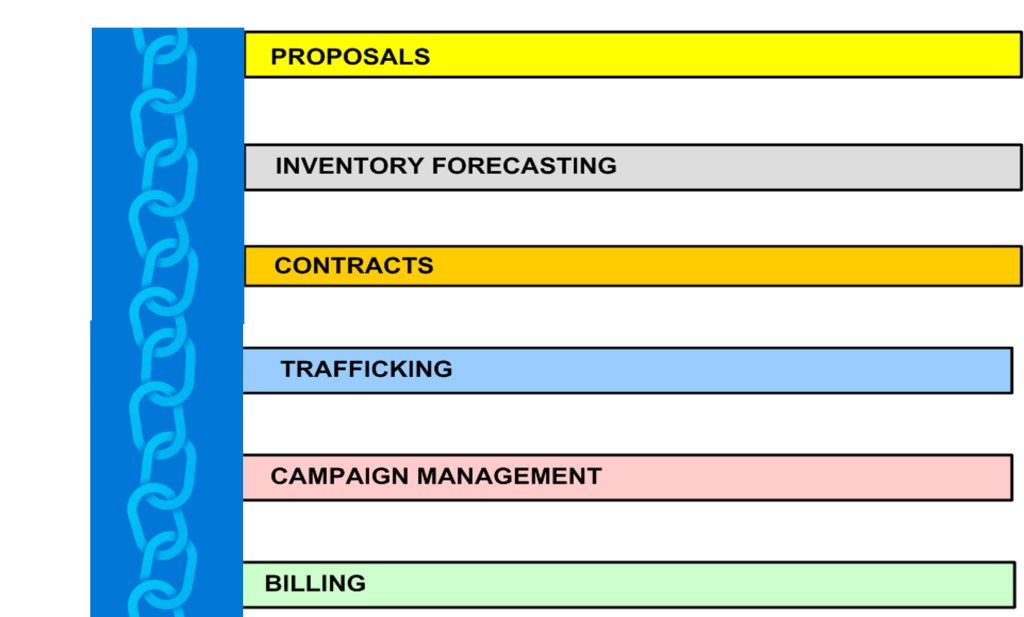
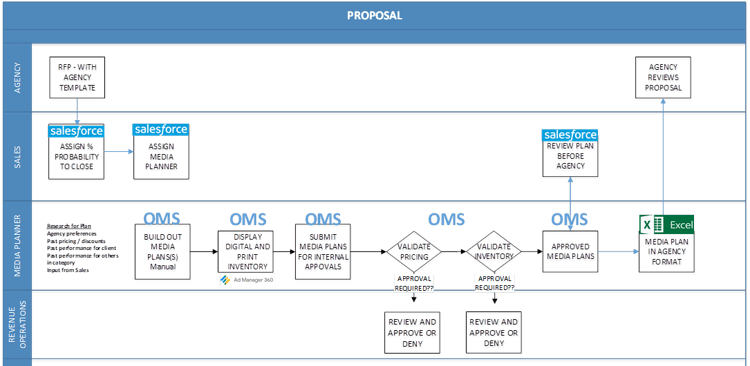
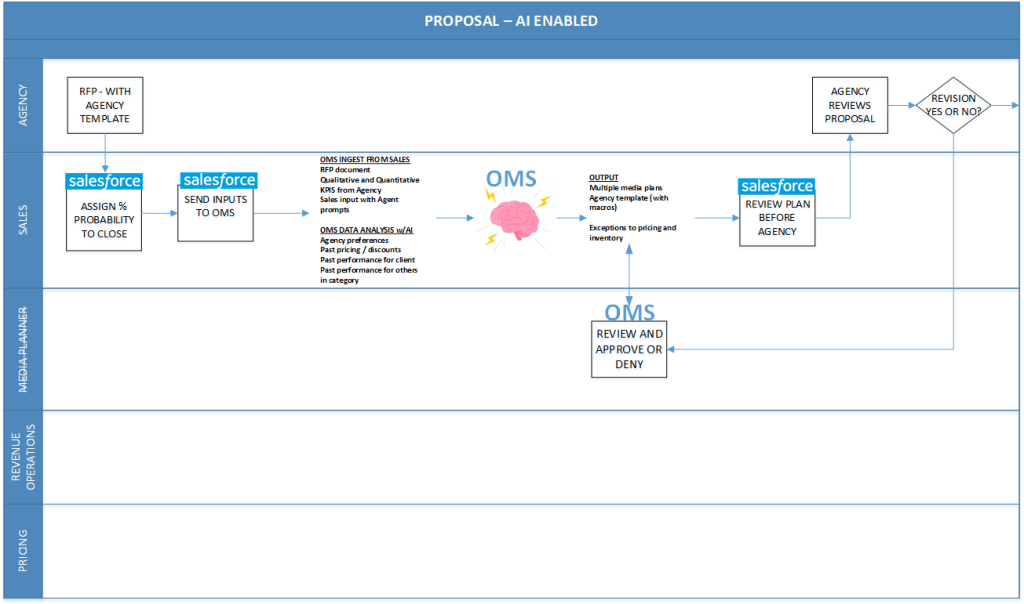
Recapping 2025, a year that was filled with significant projects for Conde Nast, Wall Street Journal, NewsCorp, WebMD, New England Journal of Medicine and Chartbeat. The work spanned 8 countries across North America, South America, UK, Europe (Italy, France, Germany, Spain) and the Middle East. The platforms included CRM, OMS, Ad Serving, BI, Billing and AI. The scope of work included managing the RFP process, project management for deployment of new platforms, configuration, ETL work for data migrations, testing and training.
Moving forward, we think 2026 will be an atypical year for one singular reason. No surprise that it is centered around AI.
“FOMO* meets Reality Check”.
In 2026 +, the headline for publishers (and agencies) will be “FOMO meets Reality Check”. Revenue Operations professionals will be examining AI driven solutions because they will be compelled to by their management and their peers. They will need to consider the following when it comes to AI-enabled platforms supporting sales and media operations:
Are the benefits of the AI solution confined to single aspect of workflow, such as media planning?
Is the vendor’s AI solution fully developed, with a track record of supporting major clients? Or is it a work in progress?
Can KPI’s be defined to determine the effectiveness the AI solution, as it becomes integrated into the ad stack?
Will the addition of an AI enabled platform increase operational efficiency, or will it add yet another series of steps on top of the existing end to end workflow?
How will data produced by the AI platform be integrated into existing business intelligence platforms?
How will the AI solution be integrated with existing platforms (CRM, Ad Serving, etc.)?
There will be significant benefits from AI over the course of time. But for the short terms, we expect Publishers and Agencies to spend a good amount of time defining exactly where and how it is incorporated in their end-to-end workflow. Of course, we can help with this.
Happy Holidays and looking forward to an exciting New Year.
Doug Wintz
www.dmwmediablog.com
www.dmwmediaworks.com
*FOMO = Fear of Missing Out”
(AI was NOT used in the composition of this post)
Category Archives: Uncategorized
Here’s Looking at Your Future, Kid
Originally published in IMediaConnection. October 17, 2005
Doug Wintz travels to 2020 to see how today’s dysfunctional mediascape will evolve into a sophisticated real-time trading marketplace.
Technology gives birth to applications that measure activity
and make decisions at an increasingly accelerated pace. Examples are numerous, ranging from the computer in your car that regulates engine performance, braking and passive safety systems, to the systems that drive the financial markets of the NYSE and NASDAQ.
As these systems are introduced, they change the way businesses are structured, create the need for new skill sets and force companies to rethink how they approach traditional markets.
The media business is not exempt from this effect. Measuring online activity is
becoming more sophisticated. As this trend continues the traditional roles of
marketing directors, media planners, buyers, media operations execs and staffers will change.
The following is a look at an alternative future that might be the result of these changes to our business.
Welcome to the year 2020
At 6:00AM on May 4, of 2020, Toshiko Jones took the elevator down to the
ground floor of her residence and waited patiently for her car service. While she waited, she surveyed the horizon of lush green mangroves on one side and an expanse of placid, slate-grey ocean on the other. Her Gulf Coast home was located in an exclusive development, a retreat occupied by the elite and wealthy.
Toshiko could afford it. Her firm, Media Asset Management (MAM), handled the purchasing and distribution of advertising for the top 10 corporations in the United States. She was one of a handful of individuals with expertise in the real-time purchase, placement, optimization and measurement of multi-media campaigns. The roles of the media planner, buyer, trafficker and marketing manager had converged into a new function — a Media Asset Manager.
Like the most prestigious financial asset management firms of the past (Fidelity, SmithBarney, et al), media asset firms now had corporate clients who entrusted them with exorbitant budgets and relied on them to generate the highest return on their investments. So MAM was responsible for buying, selling and placing media on a minute by minute basis across all media channels including Vidline, Satradio and Print.
Even conservative clients who balked at this model eventually saw the value in
granting a company or individual the aggregated responsibility and authority to plan, buy, sell, traffic, measure and optimize media in the same way that stock portfolios were managed.
After all, it was done real-time now. Companies who insisted on giving their
permission on each and every aspect of media buys and placement quickly found that they didn’t have the time, attention or expertise to evaluate and optimize every five minutes. Companies who refused to get in the game found that their brand, their sales and their futures where outflanked by competitors who felt perfectly comfortable letting control freaks like Toshiko and MAM take the reigns
of their media budgets.
Toshiko grabbed a handful of jet black hair, pushed it away from her neck and
held it for a moment. The sea breeze was warm, and heavy with humidity. She
heard the whir of the hybrid from the frontage road, anticipating the arrival of the limousine. She let her hair fall and collected her bags, eager as always to make the trip to New York and present her media strategy to a new prospect — in this case, Danbury Genetic Enhancements.
As she often did, she reflected during the outbound trip on events that took her from being a simple ad trafficker to CEO of MAM — a company that leveraged the enormous change in media to achieve a valuation that rivaled old school edifices like Chase, Microsoft and Google. Again, the same question arose in her mind…
The past evolves into the future
How did the dysfunctional mediascape of 2005 evolve so rapidly into a real-time marketplace whose sophistication in trading rivaled the New York Stock
Exchange?
After all, 2005, the media landscape was a mess. A large corporation could look forward to working with a creative agency, a media buying agency, an interactive agency, a direct marketing agency. Yes, yes, there were large global agencies who gave the appearance of doing it all, but at best their internal divisions seldom knew what each other was doing. At worse, the agency was a virtually a shell that outsourced to dozens of independents.
In 2005, the operations landscape fared no better. You could expect to traffic
scores of creative files and equal number of media outlets. Video was sent to
broadcast companies. Audio to radio. Gifs and rich media to hundreds of
websites. Bluelines were messengered back and forth to print vendors.
The change for the better was precipitated by the following breakthroughs that took place over the last fifteen years:
• Broadcast, online, ecommerce and direct marketing were consolidated
into a single subscriber service dubbed “Vidline.” This was the realization
of convergence. The old-style TV went the way of the eight-track. The PC
as a stand-alone device fared only slightly better — it was used by the
same types of curmudgeonly Luddites who once said the CD would never
replace the cassette deck.
• Media operations converged into a single application that supporting all
media, brought about by the rollup of companies who once were focused
exclusively on ad serving, or video content management, or email
distribution, or audio, or ecommerce transactions, or print. A single
application now handled that distribution and reporting task across all
media. Toshiko’s MAM was one of three companies who accomplished the
rollup of these operational functions.
• Buying media gradually changed from a process that focused on a largely
manual process of matching audience with programming, to a real-time
trading exchange whose buyers and sellers could shift media dollars on a
minute by minute basis, depending on their goals in branding, cost per
lead, ecommerce, et cetera. Up-front buys still existed, but the basis for
negotiation had adapted to the changing marketplace.
• Measurement of branding effectiveness was now real-time. The creation
of the Rickert Branding Scale gave companies like Toshiko’s the ability to
gauge not only the direct response aspects of media, but the branding
effectiveness as well and with the same real-time reporting. The
methodology included measuring the number of subscribers who viewed
the commercial messages, the potential number of family members
viewing, the duration and attention paid to the message, and their value to
the product in terms their demographics. It was a kind of EKG for the
brand.
Lost in thought and reflection, the time passed quickly and
Toshiko found herself at her destination at 53rd and Park.
The old Lever Brothers building still had an elegance that enabled it to withstand the test of time. The fact that Danbury Genetic chose it for the corporate headquarters was, perhaps, a good omen.
The presentation was held in the boardroom — a massive room that seemed out of proportion to the total number of attendees. Rice Hopkins, CEO and Heather Williams, SVP of Marketing were the attendees, both seated at the head of a rich, mahogany conference table. Toshiko positioned herself a couple of seats away. Close enough that she could still see her audience, far enough to establish a distance that hinted at the exclusive expertise she brought to the table.
“Toshiko, thanks for your time,” began Rice. “We’ve had a lot of discussions and I see this as the decision making meeting. To recap, we’re old school when it comes to marketing. In the past we’ve exercised a lot of control. We use agencies who present the creative ideas, separate media groups that present strategy and tell us where, when and how our name will be presented. We really can’t assess the results until well after a flight has concluded. It’s a very hands-on process that, frankly, is time intensive and manual”
“As we’ve discussed, Mr. Hopkins, that eats a lot of your time,” Toshiko said.
“True enough,” he said. “But it’s hard to give up control. Part of that is me; part of it is our product. We engineer genetic changes in utero for parents who want to customize their kid the same way their grandparents customized their cars. All of our marketing is heavily regulated by Federal guidelines, and we ourselves have to make sure our claims are balanced with disclosure on the risks.”
“Understood,” Toshiko said. “And that’s one area we don’t want to get involved in — the creative.” [2025 edit by Doug Wintz – yeah, and even creative is now automated by AI, so my future self sees I missed that as a forecast.]
“Listen, can we cut to the chase?” Heather asked. She shifted in her chair with
visible impatience. Toshiko couldn’t blame her. Heather was about to cede control of a valuable marketing function. Her role would be diminished. Rice gave her a good glare, and then nodded at Toshiko.
The media maven as media trader
Toshiko plugged in her laptop, toggled the display so that the MAM Control
Screen filled up the 8 x 6 foot flat screen at the end of the conference room.
“Great. Let’s go.” Toshiko rose to her feet. She always felt better presenting on
her feet, pacing and gesturing to stress her points. “You’ve given me a test budget of $250,000 to prove that MAM can do better than your traditional methods. You would spend that money anyway, and it’s a fraction of the $75 million you’ll spend on various media this year. It’s a small price to pay for a test that will change the way you do business forever. So, I’m going to take that money and invest it now in your vidline schedule. It’s 5:45 PM now, and over the next couple of hours we’ll put that money to work for you.”
“As you can see, I’ve taken the money and allocated it to the traditional media you currently use. See the tab marked ‘vidline’? You’ll see there are placements that are scheduled for 6 PM airing — two minutes from now — across NewsCorp, GoogleVision, YaNews and BBC.” She let it sink in. “In sixty seconds, we’re going to view the initial results of those placements.”
Toshiko focused on the media dashboard. Selecting the “vidline” tab transformed the screen into a series of four separate grids, one for each distribution channel. In the corner of each grid, a bar pulsated as if waiting for something to happen. At 5:59, something did. Toshiko click on a rapidly flashing, blue asterisk labeled “Distribute” and at once each grid sprang to life filling the screen with bars and lines that took on a life of their own.
Toshiko’s expert eyes translated the activity in an instant and she narrated for
Rice and Heather. “We just distributed your creative to the four target networks and now we’re viewing the responses to your marketing campaigns. We can measure the response to your video commercial by counting the requests for additional downloaded information packets as well as increases in your call center activity. In addition, the line traveling along the “y” axis shows the changes to the Rickert Branding Scale.”
“Let’s see what the impact is from these first placements,” she continued. The
NewsCorp placements have done extremely well, generating 25 percent more
leads and increasing the Rickert Scale from the baseline by 35 percent. That’s a relatively high index for your category and product — and it means that both response and branding have increased. But the YaNews placement really
bombed. Let’s see why… ah… they’re promoting the Amor Awards with graphic video segments. No wonder the attention is off your product. Nice of them to keep that programming change a secret.”
“So, what do we do? I want to sell your YaNews flight on the open spot market. Someone will snatch it up with a product that is a better fit for the programming. Let’s heavy up on the NewsCorp placements by trading or purchasing on same media marketplace and see the effect. I’ve initiated that change now. Next placement airs in five, four, three, two, one.”
And so it went for the next hour. On a minute by minute basis, Toshiko shifted the balance and placement of media in reaction the performance of each distribution channel. Both the increase in the Rickert Scale for branding and the actual response were important. Sometimes the change in a broadcaster’s programming influenced results, sometimes a local breaking news story diverted a metro population’s attention, necessitating a shift of media to an adjacent market. Changes in distribution material could be made as well, by sending subtle changes to brochures or telemarketing scripts electronically. Thus, conversion could be impacted as well.
The demonstration came to an end. Toshiko took her hands off the keyboard,
wiped her brow with the back of her shirtsleeve and faced her prospects, letting it all sink in.
“Well, what did that prove?” spoke Heather. Toshiko couldn’t have set it up any better if she supplied Heather with the script.
“Good question, and here’s the answer,” said Toshiko as she toggled the screen display. “You’re now looking at two screens. The first screen shows the projected results of your marketing campaign if you had allowed the placements to go on unchanged over the course of a full week. At best, results flatlined, and in general, their effectiveness diminished over time. The second screen shows the projection given MAM’s active management of your media assets. In just the first hour alone, we increased the Rickert Scale by 45 percent over traditional static placement and increased measurable response by 25 percent. Put into numbers, we just generated an additional $500,000 in leads and projected sales for your services in the one hour I’ve been sitting here.”
“So,” summarized Toshiko, “you can either continue to do things old school and have your competition overrun you, or you can give up control and let the experts in media buying, distribution and operations actively manage your account on a minute by minute basis. You give up your financial assets to SmithBarneyWatch –you’d be just as smart to give your media assets up to MAM.”
And with that, Toshiko closed the display and calmly stared at her newest clients.
So is this science fiction or science future?
I believe this is a plausible future. The internet has driven a measurement
revolution in media that won’t go away. As media converges, that same
accountability will become as much a part of the traditional vernacular as GRPs are today. Decision making will be fast and furious, and — like the fund managers who manipulate stock portfolios today — a new class of experts will be responsible for getting the best yield out of a media budget.
Minute-by-minute.
Hour-by-hour.
Day-by-day.

Making Branded Content a Seamless Process Through AI
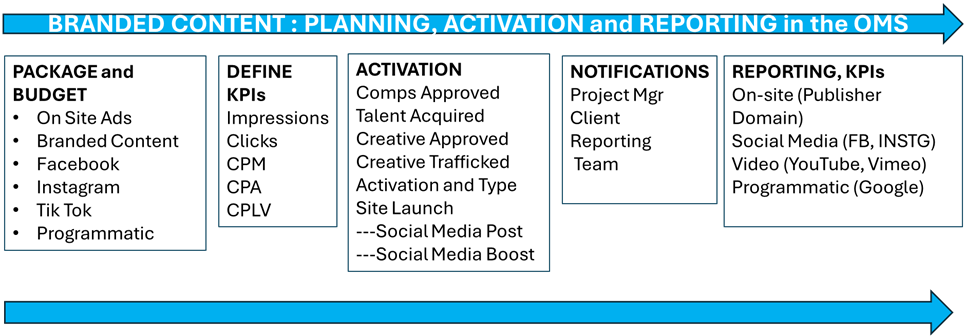
We are so close, yet so far from the efficient management of large-scale branded content campaigns. Several companies provide the capability to create the media plan, traffic digital assets, extract digital performance data from both on-site and off-site (social media) placements and consolidate reporting on those elements.
But a major, branded content, cross-media campaign for a Tier 1 client encompasses so much. Several improvements are necessary in order to create a single entry point for the creation, management and reporting of all branded content elements and AI could definitely play a role.
This does not have to be a nightmare of coordination between a publishers marketing and and operations groups. Ideally, it is all centralized within the publishers OMS.
These include the following features:
Project planning and coordination, enabled by AI, all within the OMS because there are so many elements that today need to be tracked as separate processes.
When custom creative is required, set the due dates for each step leading to the completion of production-ready creative assets
If talent is involved, include the timeline for choosing and licensing that content.
AI can create the plan, showing the explicit start date and due dates for all elements of the branded campaign across all media and production, online and offline.
Designate who needs to approve each element of the campaign and who needs to be notified.
Real-time optimization triggered by the KPIs for each line item.
A graphic with all the elements is below.

All of this is within the realm of possibility for an AI enabled module within the OMS.
As publishers seek to deliver more value to their major advertising clients, they will need in internal process that is centralized, coordinated and managed from a single OMS module.
For Publishers, AI is a Slippery Bar of Soap

There is no doubt that AI is transformative. In sales and ad operations, it has the potential to reduce or even eliminate the friction that is part of the everyday process of getting a campaign from quote to cash.
However, there are some limitations. And it’s less about the technical limitations and more about the limitations imposed by human beings.
We can break out the potential benefits that AI could offer for a publisher’s direct sales and ad operations as follows:
SLAM DUNK
Media planning
AI vendors have already introduced the ability to automatically create proposals and media plans, which are informed instantaneously by historical results for that particular client, and can help predict the optimum plan moving forward.
STRETCH GOALS
Workflow
Designing and optimizing workflow, including approval processes, user roles and permissions, could all be streamlined by AI. Ingest a publisher’s current workflow and make recommendations for improvement and even configure the optimal workflow in the OMS.
Ad Product Taxonomy
Similar to the potential improvement above, AI could translate a publisher’s current taxonomy and make recommendations for improvement which could include making a product catalogue more “findable” for proposals and more efficient for inventory management and trafficking.
Inventory forecasting
I would hope that AI can do a better job of forecasting than the tools we use today. This could include a stronger link to the real time performance of content, which has a real time impact on advertising inventory. Additionally, creating forecasting that is instantaneously linked to historical inventory trends from seasonal and tentpole events would increase accuracy.
Optimization
Automating the optimization of direct sold campaigns and recommending improvements would be a boon for inventory managers. The “stretch” in this goal is the need to manually confer with an advertising client and obtaining their approval for the changes in an optimized campaign, or setting up the permission beforehand to make changes on the fly.
Salesforce.
Any AI solution that hopes to create a single point of entry to manage the quote to cash process is going to have to navigate around Salesforce. In some cases, adding yet another application between the CRM and OMS will be a hurdle. In other cases, proposing to replace SF with a new AI enable solution which would be truly end to end will run into the need for sales to cling to their current CRM.
BLOCKERS
Third party ad tags
If every ad tag received by an agency was 100% functional, this would not be an issue. However, it’s not the case. AI “could” ingest, process and traffic ad tags automatically. But because there are human operators on both sides, the troubleshooting process will continue to be manual. This is a blocker for an AI enabled trafficking process.
Billing and Invoicing
If every campaign billed on publisher delivery numbers, this would not be an issue. However, it’s not the case. Every billing cycle is an exercise in verifying the invoice reflects the ad agency’s delivery numbers. There is a highly manual verification exercise that takes place each billing cycle, to the extent that the “real” accounting is not locked down for several days. This is a blocker for an AI module that would allow invoicing at the touch of a button.
In summary, I think that AI can do sales and ad operations a world of good, but the barriers to entry will be less about the technology, and more about legacy processes, institutions, and of course, people.
What We Have Done….So Far
Wall Street Journal/Dow Jones/NewsCorp: Client since June 2018
Responsible for managing the search for a new order management system supporting Dow Jones, and for the project management of its implementation. Currently hosting a reporting and billing service, transforming data from the OMS for ingestion by client’s internal systems. Separately, advised NewsCorp on ad server technology, as well as technical evaluations of ad code across global NewsCorp properties and recommended improvements.
WebMD: Client since June 2004
Engaged as Project Managers for implementation of WebMD’s order management system which included integration with Salesforce and the GAM ad server. Responsible for data migration leveraging the OMS and GAM APIs. Currently, we host custom software to enable bulk editing and management of WebMD’s ad product catalog.
New England Journal of Medicine: Client since 2014
Advising New England Journal of Medicine on ad platforms and best practices in digital ad operations ranging from order management, ad serving and trafficking to data management platforms. Includes consultative work on the impact of media fragmentation and AI on digital advertising.
Conde Nast: Client March 2016 – 2025
Engaged in the deployment of ad platforms for Conde Nast. Embedded with the global project management and data migration teams, rolling out a new CRM, Order Management and Invoicing platform to the UK, Spain, Germany, Italy, France, Mexico, and Middle East.
The New York Times: Client June 2007 – January 2020
Engaged in recommending and implementing changes to their advertising and platforms from order management systems to ad servers. In 2019, we managed the data migration project for NYT’s move to a new order management system linked with Salesforce. Created training materials and performed in-market training and hyper-care in both NY and London offices.
Google: Client February 2012 – January 2019
Engaged as project managers for the migration of Google ad platforms. Our first cycle was moving Google clients from their legacy ad server to GAM. Our next cycle was implementing Google’s order management platform. We were assigned specific clients in part based on our ability to perform data mapping and API-based migrations for their Tier 1 clients such as Viacom, LinkedIn and ESPN.
McClatchy Publishing: Client Jan. 2019 to July 2022
Engaged as project managers, deploying MC’s next generation ad platform, which consolidated management of digital and print from 6 platforms, to a single unified platform. Conducted an evaluation of their end-to-end processes and applications including Salesforce, AdBase, DFP, XPanse (creative management), Salespoint and Oracle. Worked with both national and regional stakeholders. Recommended options to either retrofit, reduce or replace their ad platforms, and helped McClatchy select AdPoint as the vendor.
Hearst Magazines: Client May 2015 to June 2022
Engaged as project managers for Hearst ad platform migrations including order management systems. Managed the migration to a combined digital / print order management system platform, AdPoint, in support of Hearst Magazines. Includes requirements-gathering, documentation of the future “to be” state and managing both vendor and internal Hearst stakeholders.
Las Vegas Review Journal: Client October 2022 – January 2024
Project manager for implementation of new CRM, Order Management and Accounts Receivable platform, supplied by Lineup’s AdPoint system. Assign tasks and track deliverables LVRJ and LineUp in support of an October 2023 launch.
Tribune Publishing Client January 2019 – June 2023
Project Managers for the implementation of Tribunes’ order management system. Supported Tribune with data hosting of advertising revenue reports, and creation of monthly billing files.
Viacom/Paramount: Client 2014 – 2021
DMW has provided project management, training, change management, ad operations and migration expertise for Viacom Digital. In 2020, we created the network design for Viacom’s video ad product catalog and commercial break patterns in Freewheel. In 2021 we trained incoming sales support staff on their end-to-end ad platforms ranging from CRM to Order Management to Ad Serving and BI reporting including Salesforce, Operative, Google, Freewheel and BI systems
Spotify: Client June 2017 to December 2022
Engaged with Spotify to evaluate workflow and platforms supporting digital advertising and create the next gen order management platform to support this global entertainment and media company. Project Managers for the deployment of a new OMS in conjunction with Salesforce and Google platforms. Engaged in a multi-year data management/hosting agreement, producing real-time reporting on media revenue.
Expedia: Client from June 2019 to January 2021
Engaged in documenting business requirements used in evaluating a new order management platform. Led the RFP and review process, recommended the OMS solution currently being adopted by Expedia.
LinkedIn: Client February 2015 – January 2018
Engaging in several cycles of platform and data migration for LinkedIn from legacy sales and marketing platforms to their in-house Salesforce platform. Enabled LinkedIn to maintain day to day business operations while shifting to new digital platforms and launching with zero data defects, despite the requirement to provide automated migration of 50,000+ line items and creatives.
PGA Tour: Client January 2015 to December 2022
Evaluated operational workflow and order management platforms for PGA Tour. Led the RFP process and implemented the configuration and launch of Operative in support of digital ad sales and operations. Currently engaged in implementing DAI and VOD distribution projects with partners such as XUMO. Sourcing out CDN and transcoding partners for PGA internal ad operations.
Scripps Digital: Client from April 2014 to January 2015
Led project management for new ad code deployment across Food Network, HGTV and Travel Channel. Created and executed testing and QA processes to validate proper ad display, targeting via key values and ad creative functionality during deployment of their ad server. Required managing resources across web development and ad operations divisions, both external and internal resources.
Pandora: Client March 2013 to December 2013
Assisted in the deployment of DFP ad server as part of the Google / Pandora management team. Trained Pandora traffickers in best practices in trafficking in DFP and generating reports through the DFP Query Tool.
Weather.com: Client January 2011 – June 2013
Engaged in evaluating sales and operations processes at this Atlanta based content company, highlighting gaps in workflow and applications, and making recommendations for improvement and adoptions of new technologies to aid digital sales, focusing on a new order management (OMS) system. Participated as a member of internal project team to launch new ad serving platforms including DFP Premium.
Jumpstart Automotive Media: Client from March 2007 to January 2011
Jumpstart is the internet sales and ad operations division for Car and Driver, Road and Track, JD Powers, Vehix. Consulted on “best practices” in sales operations and workflow during the launch of the company. From 2008 – 2011, created custom inventory reports to automate trafficking and increase targeting capabilities and custom revenue reports to support affiliate partners. Now owned by Hearst.
NBC Universal: Client March 2013 to May 2014
Managed and executed end to end QA and testing processes associated with adoption of new order management platform, deployment of upgraded ad server XFP and integrations Salesforce and Freewheel. Created product requirements and testing scripts across NBCU properties and executed on those script to certify readiness of launch.
American Medical Association: Client from June 2009 to February 2010
Responsible for building in-house ad operations capabilities including sourcing, evaluating and negotiating with ad serving, contract management and trafficking resources. Created training programs for in-house print staff on digital media. Deployed ad serving platform DFP
Discovery Channel: Client Oct 2010 – July 2012
Evaluated workflow and process in digital ad operations, and recommended changes to improve efficiency. Based on business requirements, evaluated OMS / ad serving options and recommended options for new platform at Discovery.
Meredith Publishing: Client May 2012 to September 2012
DMW MediaWorks was engaged in managing the implementation of new ad serving technology for this network of over 20 premium websites including Better Homes and Gardens. Includes project management and interaction between vendors, ad operations and development groups to launch upgraded ad server and consult on consolidation with other businesses units such as AllRecipes.
Turner Broadcasting: Client from October 2006 to September 2008
Engaged in evaluating internet ad operations applications and workflow. DMW recommended short and long-term strategies for improvement including review of both linear and digital applications. Managed the relationships between vendors (DoubleClick), and internal product and technology managers to launch a series of new Turner entertainment sites. Guided internal product development teams in best practices in developing custom ad serving applications.
A&E: Client from July 2007 to December 2007
Engaged in evaluating ad operations and sales at AE including the ad products, systems, staffing and workflow associated with processing online orders. This includes producing recommendations on ad product development, inventory management, trafficking, ad serving/contract management software and billing.
AutoTrader: Client from March 2007 to August 2007
Engaged in evaluating advertising operations at AutoTrader and making recommendations on industry “best practices” in end-to-end workflow including management of the sales process, ad inventory, contracts, campaigns and billing.
Universal Music Group: Client from June 2007 to December 2007
Engaged in project management for the creation of an in-house digital media operations group, including deployment of an ad server and video player across music labels Island/Def Jam, Motown, Interscope and Geffen. Project involves coordinating and managing of cross functional departments of IT, Sales, Production Management and Finance.
Viacom Television Station Group: Client August 2004 to October 2005
Accountable for building the media operations group in support of 33 CBS and UPN TV station websites. Included evaluating, selecting and implementing ad serving, contract management and site analytics solutions. Recruited staff and trained sales on online media and affiliates on ad operations procedures.
InterActiveCorp: Client July 2005 – February 2006
Engaged in evaluating and implementing media operations applications across a network of sites including Ask Jeeves, Ticketmaster, Expedia, Evite, Excite, IWon, CitySearch and Match.com. Focused on creating integration solutions for media operations among the recently merged companies and deploying behavioral targeting across network.
What Music Taught Me About Media Operations
I believe we end up where we are meant to be. Our personalities and experiences dictate the type of work we choose, the families we create, the life we live.
In my first life, I played trombone for a living through the 1970’s and 1980’s. This included tours with Ray Charles, Tom Jones, Quincy Jones, Louis Bellson and a slew of great jazz and pop musicians. You can hear some of it with the group Baya, with Heat, Shuggie Otis, Supertramp and my own recordings.
Little did I know what I learned in that career would ultimately make me well-suited for my career in media operations, because of the following:
Hours spent in a practice room teach you to be focused, self-disciplined and self-motivated.
When you play in an ensemble, you must listen (LISTEN!) to your section mates and work collaboratively.
Nobody cares about who you are, where you come from, your background, or who you know. Respect is given to those who can play and get the job done.
You must learn to improvise.
Your reputation and track record are your resume.
You will be out of work. Find a way forward.
You will fail. Use your failures as a roadmap for improvement.
No one will dictate your schedule. You must be self-sufficient.
After spending nearly 20 years in my first career, I have ultimately ended up spending the last 20 (and counting) running DMW MediaWorks, comprised of a small band of media operations players, who are self-motivated, who work collaboratively, are great improvisers, and know that their work is their reputation.
Was music a more glamorous occupation than media operations? I’d argue that when you have the opportunity to work for companies like New York Times, Conde Nast, Wall Street Journal, Viacom (now Paramount), Google, WebMD, New England Journal of Medicine, Hearst, Expedia, LinkedIn – those are marque names and associations in their own right.
So, to bring it all full circle, I believe we end up where we are meant to be.
50 Tasks that Rev Ops Pros Swear By When Configuring OMS Platforms!
It must be common knowledge that putting a number in a headline increases reader engagement and clicks. Just today, I saw the following on CNN.com
- 20 Amazon products our readers loved buying in October
- 53 stocking stuffers that make small gifts feel extra special
- The 23 best food gifts for people who take eating seriously.
- 30 cozy gifts for the person who loves staying in.
So, I figured I would follow the experts in journalistic integrity in writing a headline that describes the challenge of creating a foundation for best practices in rev ops.
(At the end of this post, see a series of hilarious AI alternatives to this headline. Honestly, it’s worth skipping to the bottom:)
Here we go with….
50 Tasks that Rev Ops Pros Swear By When Configuring OMS platforms
AD PRODUCTS
- Define the ad product catalog, or taxonomy.
- Design the optimal structure that will support sales and planning, trafficking, reporting and billing
- Determine if these will be basic size/position ad products. Or if they will be further defined in the catalog with multiple key values for targeting.
- Document and configure any pre-determined ad packages and the rules for editing them. Including ad units and fixed costs such as production charges.
- If these are print products, define and configure the page position, issue, publishing date and close dates for the next 12 months.
- If these are video streaming products, define the positions as pre-, mid-, or post rolls.
- If these are video streaming products, determine what metadata will be attributed to them.
- Define commercial break patterns so they can be associated with the ad products.
- Define how revenue recognition will be calculated based on the delivery of individual components in an ad package.
- Define, as part of user roles and permissions, who can view product attributes and who can edit them.
- Configure the product catalog in the OMS. Perform UAT, then reconfigure again based on feedback.
RATE CARDS AND PRICING
- Determine if there will be 1 rate card, multiple rate cards, country specific rate cards, seasonal rate cards, specific rates for agency holding companies.
- Define the discount structure and configure the types of discounts in the OMS.
- Define any pricing floors that, if exceeded, will trigger workflow rules requiring approvals.
- Volume pricing – what part does volume pricing play in calculating discounts in real time OR as a year end rebate strategy.
- Which currencies will be used, by whom, and for which products?
- Define the process for calculating and updating currency exchange rates.
WORKFLOW
- What is the source of truth for accounts, contacts and credit status? Does if flow from the billing platform to the CRM (like Salesforce)? Or is the source of truth the CRM, which flows to the OMS (order management system)?
- Define the sales stages for both the CRM and OMS.
- Define when opportunities in the CRM push to the OMS. At what status will that happen?
- How will sales knowledge about the proposal be handed off to the media planner?
- Define how multiple proposals for the advertiser will be handled in the OMS. How will the primary, advertiser approved media plan be flagged for completion?
- Define any deal parameters that are triggers for approval by sales managers, inventory managers and/or finance.
- At what point in the workflow is an order considered “closed/won”? How is that reflected in both the CRM and OMS?
- What order information needs to flow back from the OMS to the CRM, so that revenue totals are in synch across both platforms?
- Define the order revision process and determine the conditions under which a revised order needs to cycle through the approval workflow.
TRAFFICKING AND AD SERVER INTEGRATION
- Define how key values from the ad server will be pulled into the OMS.
- Will “English Names” (aliases) be applied to key values that are numeric, so planners know what value to select?
- Validate that inventory avails are pulled into the OMS from the ad server during media planning and through the final contracted order.
- Perform mapping between ad server’s ad products and those in the OMS
- Define the process for pushing completed orders and line items from the OMS to the ad server.
- Define and document any error messages associated with pushing line items to the ad server, and their resolution.
BILLING AND INVOICING
- Define and map the fields that will be sent from the OMS to the billing platform.
- Determine the billing cycle. Will it be daily, weekly, monthly or ad hoc?
- Define how third party delivery data will be incorporated into the OMS.
- Define the process for actualizing the billable data which may include pulling third party data manually.
- Define the billing adjustment process.
- Define the credit process.
- Configure the invoice templates and determine which data from the OMS will be included and which will be “hidden”.
DATA MIGRATION (from legacy system to new OMS platform)
- Decide if this is a manual migration or automated migration leveraging the OMS API
- Define the acceptance criteria that internal auditing and compliance stakeholders will use to validate the data migration. Build it into the timeline
- Define the parameters of the migration – will it include active campaigns only, or will it include historical campaign data.
- Map the data between the legacy ad platform(s) and the new ad platform.
- Remove blockers from migration, which will generally include workflow rules, mis-configured products, etc., so that the data loads can be applied without interruption.
- Create the order Lines
- Synch the ad server lines
- Populate custom fields at the line item level
- Update order status(s) before system use.
- Conduct QA and create a report detailing any errors in migration data (missing products, pricing config, etc.) and submit IDs and records of any migration lines that were in error.
- Conduct supplemental data loads as required to complete the initial launch data set.
By the way, AI was NOT used in the composition of the above article.
However, Chat GPT WAS used to come up with some alternate takes on my headline. I think they are pretty hilarious, but also better than mine!
“50 Must-Do Tasks Every RevOps Pro Tackles When Setting Up an OMS”
“RevOps Leaders Reveal the 50 Tasks They Never Skip When Configuring an OMS”
“The 50 High-Impact OMS Setup Tasks That Maximize Revenue Efficiency”
“The Ultimate 50-Point RevOps Checklist for OMS Configuration”
“Avoid the Chaos: 50 Tasks That Keep Your OMS From Breaking Down”
“From Sync to Scale: 50 OMS Configuration Tasks That Power Seamless RevOps”
“50 Modern OMS Setup Moves That Today’s RevOps Pros Live By”
“How Top RevOps Teams Configure OMS Platforms: 50 Tasks That Define Operational Excellence”
Automotive Innovation – The First Online Owner’s Center
Early online services such as Prodigy, Compuserve and AOL broke new ground, finding new ways to engage with their subscribers. In the 1990’s the automotive industry took a leap of faith and jumped in on the action. There were services like Autobytel, one of the first online buying services. Major manufacturers also participated, including Toyota.
In the early days, it was possible to work directly with the manufacturer and bypass their advertising agency. This was the case with Toyota, and I was fortunate enough to work with Jim Pisz, who was a direct response manager at the company. He was (and still is) a visionary. Like the clueless salesperson I was, I went in trying to sell him advertising to Prodigy’s 1 million subscribers. He was smart enough to ask a pivotal question: “How many Toyota owners are among those subscribers??” Followed by, “Can we create an owner’s center for our own customers?”
After several trips to Toyota’s office in Torrance, California and several white board sessions later, the outline for the owner’s center fell into place. It would include product information, racing information from TRD (Toyota Racing Division), owners services and a bulletin board.
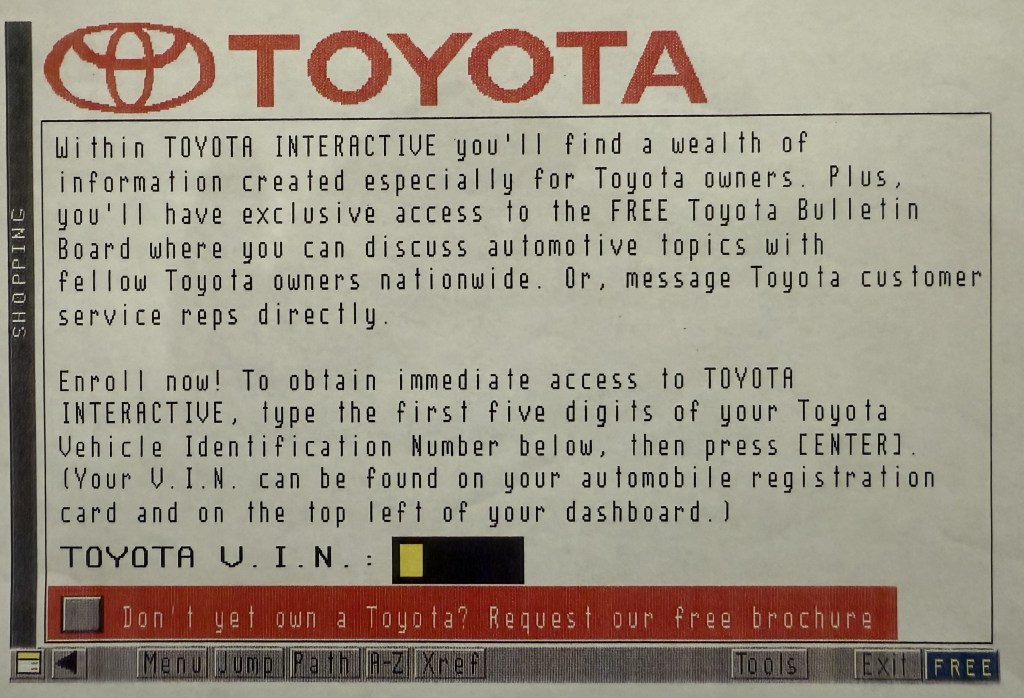
Manifesting the audience online relied on some basic direct response techniques. Prodigy subscribers were matched against Toyota ownership records. This was a classic merge and purge with a resulting tape (yes, tape) of Toyota owners on Prodigy. A Prodigy email was sent to those members, inviting them to the Toyota owner’s center where they could begin using the service without registering. New owners who came on the service entered their VIN, which would automatically register them to use the service.
We learned a lot from the project. The fundamentals of direct marketing still applied, even in this “cutting edge” new medium. Owners loved being in more direct contact with the Toyota and their correspondence reflected that enthusiasm. Bulletin boards were a two edged sword – when you asked what consumers thought about the Toyota product you got the good, the bad and the ugly. Something we see 30+ years later in social media.
Below is the home screen for the Toyota application on Prodigy, circa 1994.

…and the registration screen, for new Toyota owners who started using Prodigy for the first time.

Ma’am, the Online Grocery Order is in Your Broom Closet
Many years ago I started working as part of a team that implemented online grocery stores. This was for one of the early online services Prodigy (pre-internet), which was based out of White Plains, New York.
When we traveled to demonstrate the service, we did so with 2 huge anvil cases – one for the monitor one for the CPU. So large they had to be checked under the plane. These cases would literally come tumbling off the conveyer belt in the baggage claim area. When we did get to the grocer, we had to hunt down a phone line that could handle the 2400 baud modem. Sometimes it was in a meeting room, once it was on the loading dock at Publix corporate headquarters.
One of our clients was Dominick’s in the Chicago area, with about 20 of their stores participating in the online delivery service. This was very cutting edge at that time, and yet they made the commitment. Each store had their own PC and printer, so orders placed by consumers could be downloaded, printed, then picked and packed, staged for delivery to the customer or available for pickup.
At times, it was clear that we were asking a lot of our clients. For example, at one point we received a call in White Plains from one of the Chicagoland grocery locations. Their customers were complaining about not receiving their Prodigy grocery order. The ensuing conversation went something like this:
Grocer: “Hey Prodigy customer service, we are getting complaints that customers didn’t receive their grocery order from your service”
Prodigy: “Ma’am, you need to go to the Prodigy computer in your store and print out the order”.
Grocer: “Where is the Prodigy computer?”
Prodigy: “We don’t know where it was placed at your store, can you look?”
Grocer: “Oh, my manager set that up, but he’s not in the store today. Give me a few minutes”
Grocer: “OK! We found the Prodigy computer. It’s in the broom closet. What do I do now?”
Prodigy: “Let me walk you through the steps of finding, and printing the orders……”
There were several misconceptions about online grocery in those years. Among them:
- Convenience will outweigh selection. Wrong! The initial thought was that a smaller subset of grocery items would be “good enough” for online shoppers But, online grocery shoppers expected exactly the same products online that they did in-store. And they let us know it.
- Convenience will outweigh quality. Wrong! If an item that was picked, packed and delivered wasn’t EXACTLY what the consumer expected, credit was due.
- The economics were challenging. If it took someone at the store 45 minutes to pick and pack an order, and they were being paid union wages, it would eat into the slim (2%) retail profit margin.
- The technology had to catch up to consumer behavior. It might take someone 1 hour to place an online order, only to have the online service disconnected at the 59th minute! Thus, “save and restore” was born.
Early adopters included Grocery Express, Dominics, Schnucks, King Soopers, D’Agostino, Kroger and others.
I think of what a leap of faith the early grocery adopters took every time I get a Fresh Direct order today.
I make sure to leave a nice tip.
The X Factor: How Legacy Institutions Impact Innovation
If our media business was based only on taking the most efficient path, programmatic buying and selling would stand alone as the ONLY option, and direct buying and selling would have already disappeared. While no-one can dispute the outsized impact of programmatic, direct buying and selling still persists. The more original and well branded a publisher’s content is, the more likely that direct selling is predominant, with programmatic as an option.
Now, I’m not here to debate the merits of one over another. What I do want to introduce is the outsized impact on legacy institutions – Agencies and Publishers – in impacting the adoption of this technology. And, I believe, you could say the same about any business sector.
Agencies have long provided guidance in media buying to their clients, weighing product, audience, creative and media choices to improve the standing of those clients in the marketplace. In return, publishers and media owners have built their own staff to respond by matching quality content and ad exposure to provide results for agencies and their clients. While programmatic has whittled away at this legacy, it will take years before it replaces the legacy institutions now in place.
Another example of legacy institutions slowing things down is the buying, selling and operational management of advertising across streaming platforms AND broadcast (linear). There are actually order management platforms that can handle both media channels, as well as standard digital display. You would think in the interest of efficiency, that consolidation be commonplace by now. However, in many cases media planning and buying are conducted by two different Agency divisions, and the trafficking and delivery process is different for streaming versus linear on the publisher side. So operational consolidation remains a potential that is still being held back for legacy institutions.
This opens up a broader discussion. How will legacy institutions impact other technical innovations? Will original thought and individual voices go away tomorrow because AI is a “thing” today? Certainly, it is going to have an outsized impact, but it will be more gradual than we believe. Will banks and the existing financial infrastructure go away overnight because cryptocurrency is a “thing” today? No.
This is only to say that in calculating the impact of new technology, consider the legacy institutions that are in place and the impact THEY will have on moderating the adoption rate, which will most likely take place over a longer period of time than it’s advocates predict.
If it has not been done already, it might be an interesting exercise to turn it into a mathematical calculation when considering the potential upside of any new technology. If that has already been done, please let me know.
(No AI was used in the composition of this post)