Automotive Innovation – The First Online Owner’s Center

Early online services such as Prodigy, Compuserve and AOL broke new ground, finding new ways to engage with their subscribers. In the 1990’s the automotive industry took a leap of faith and jumped in on the action. There were services like Autobytel, one of the first online buying services. Major manufacturers also participated, including Toyota. 

In the early days, it was possible to work directly with the manufacturer and bypass their advertising agency. This was the case with Toyota, and I was fortunate enough to work with Jim Pisz, who was a direct response manager at the company. He was (and still is) a visionary. Like the clueless salesperson I was, I went in trying to sell him advertising to Prodigy’s 1 million subscribers. He was smart enough to ask a pivotal question: “How many Toyota owners are among those subscribers??” Followed by, “Can we create an owner’s center for our own customers?”

After several trips to Toyota’s office in Torrance, California and several white board sessions later, the outline for the owner’s center fell into place. It would include product information, racing information from TRD (Toyota Racing Division), owners services and a bulletin board.

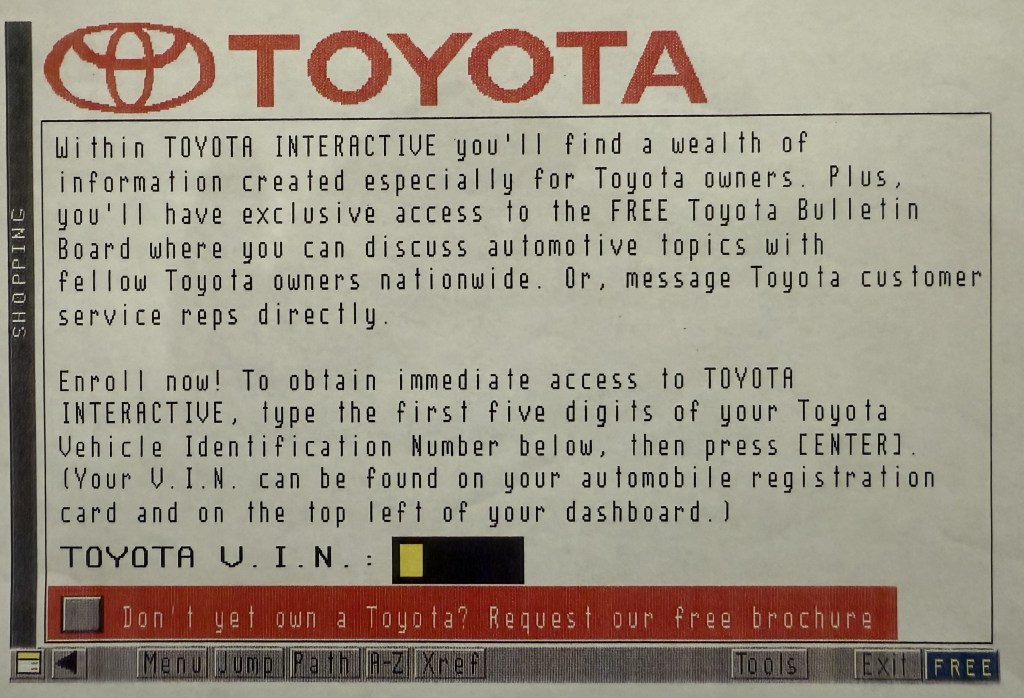
Manifesting the audience online relied on some basic direct response techniques. Prodigy subscribers were matched against Toyota ownership records. This was a classic merge and purge with a resulting tape (yes, tape) of Toyota owners on Prodigy. A Prodigy email was sent to those members,  inviting them to the Toyota owner’s center where they could begin using the service without registering. New owners who came on the service entered their VIN, which would automatically register them to use the service.

We learned a lot from the project. The fundamentals of direct marketing still applied, even in this “cutting edge” new medium.  Owners loved being in more direct contact with the Toyota and their correspondence reflected that enthusiasm. Bulletin boards were a two edged sword – when you asked what consumers thought about the Toyota product you got the good, the bad and the ugly. Something we see 30+ years later in social media.

Below is the home screen for the Toyota application on Prodigy, circa 1994.

…and the registration screen, for new Toyota owners who started using Prodigy for the first time.
Ma’am, the Online Grocery Order is in Your Broom Closet

Many years ago I started working as part of a team that implemented online grocery stores. This was for one of the early online services Prodigy (pre-internet), which was based out of White Plains, New York.

When we traveled to demonstrate the service, we did so with 2 huge anvil cases – one for the monitor one for the CPU. So large they had to be checked under the plane. These cases would literally come tumbling off the conveyer belt in the baggage claim area. When we did get to the grocer, we had to hunt down a phone line that could handle the 2400 baud modem. Sometimes it was in a meeting room, once it was on the loading dock at Publix corporate headquarters.

One of our clients was Dominick’s in the Chicago area, with about 20 of their stores participating in the online delivery service. This was very cutting edge at that time, and yet they made the commitment. Each store had their own PC and printer, so orders placed by consumers could be downloaded, printed, then picked and packed, staged for delivery to the customer or available for pickup.

At times, it was clear that we were asking a lot of our clients. For example, at one point we received a call in White Plains from one of the Chicagoland grocery locations. Their customers were complaining about not receiving their Prodigy grocery order. The ensuing conversation went something like this:

Grocer: “Hey Prodigy customer service, we are getting complaints that customers didn’t receive their grocery order from your service”

Prodigy: “Ma’am, you need to go to the Prodigy computer in your store and print out the order”.

Grocer: “Where is the Prodigy computer?”

Prodigy: “We don’t know where it was placed at your store, can you look?”

Grocer: “Oh, my manager set that up, but he’s not in the store today. Give me a few minutes”

Grocer: “OK! We found the Prodigy computer. It’s in the broom closet. What do I do now?”

Prodigy: “Let me walk you through the steps of finding, and printing the orders……”

There were several misconceptions about online grocery in those years. Among them:

  • Convenience will outweigh selection. Wrong! The initial thought was that a smaller subset of grocery items would be “good enough” for online shoppers But, online grocery shoppers expected exactly the same products online that they did in-store. And they let us know it.
  • Convenience will outweigh quality. Wrong! If an item that was picked, packed and delivered wasn’t EXACTLY what the consumer expected, credit was due.
  • The economics were challenging. If it took someone at the store 45 minutes to pick and pack an order, and they were being paid union wages, it would eat into the slim (2%) retail profit margin.
  • The technology had to catch up to consumer behavior. It might take someone 1 hour to place an online order, only to have the online service disconnected at the 59th minute!  Thus, “save and restore” was born.

Early adopters included Grocery Express, Dominics, Schnucks, King Soopers, D’Agostino, Kroger and others.

I think of what a leap of faith the early grocery adopters took every time I get a Fresh Direct order today.

I make sure to leave a nice tip.