Early online services such as Prodigy, Compuserve and AOL broke new ground, finding new ways to engage with their subscribers. In the 1990’s the automotive industry took a leap of faith and jumped in on the action. There were services like Autobytel, one of the first online buying services. Major manufacturers also participated, including Toyota.
In the early days, it was possible to work directly with the manufacturer and bypass their advertising agency. This was the case with Toyota, and I was fortunate enough to work with Jim Pisz, who was a direct response manager at the company. He was (and still is) a visionary. Like the clueless salesperson I was, I went in trying to sell him advertising to Prodigy’s 1 million subscribers. He was smart enough to ask a pivotal question: “How many Toyota owners are among those subscribers??” Followed by, “Can we create an owner’s center for our own customers?”
After several trips to Toyota’s office in Torrance, California and several white board sessions later, the outline for the owner’s center fell into place. It would include product information, racing information from TRD (Toyota Racing Division), owners services and a bulletin board.
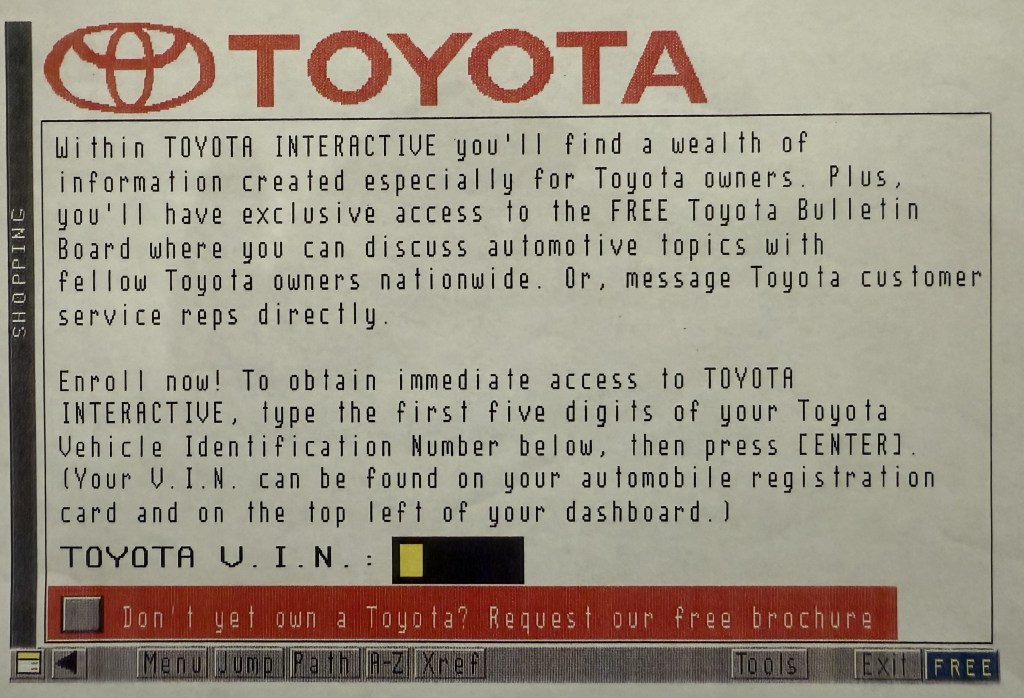
Manifesting the audience online relied on some basic direct response techniques. Prodigy subscribers were matched against Toyota ownership records. This was a classic merge and purge with a resulting tape (yes, tape) of Toyota owners on Prodigy. A Prodigy email was sent to those members, inviting them to the Toyota owner’s center where they could begin using the service without registering. New owners who came on the service entered their VIN, which would automatically register them to use the service.
We learned a lot from the project. The fundamentals of direct marketing still applied, even in this “cutting edge” new medium. Owners loved being in more direct contact with the Toyota and their correspondence reflected that enthusiasm. Bulletin boards were a two edged sword – when you asked what consumers thought about the Toyota product you got the good, the bad and the ugly. Something we see 30+ years later in social media.
Below is the home screen for the Toyota application on Prodigy, circa 1994.

…and the registration screen, for new Toyota owners who started using Prodigy for the first time.
 DMW MediaBlog