This is Part I in a series of discussions on the potential impact of AI solutions on workflow in Revenue Operations. Each part will explore one of the workflow stages, as depicted below.
The typical workflow for Publishers engaged in direct sales has stages that are co-dependent, like links in a chain.
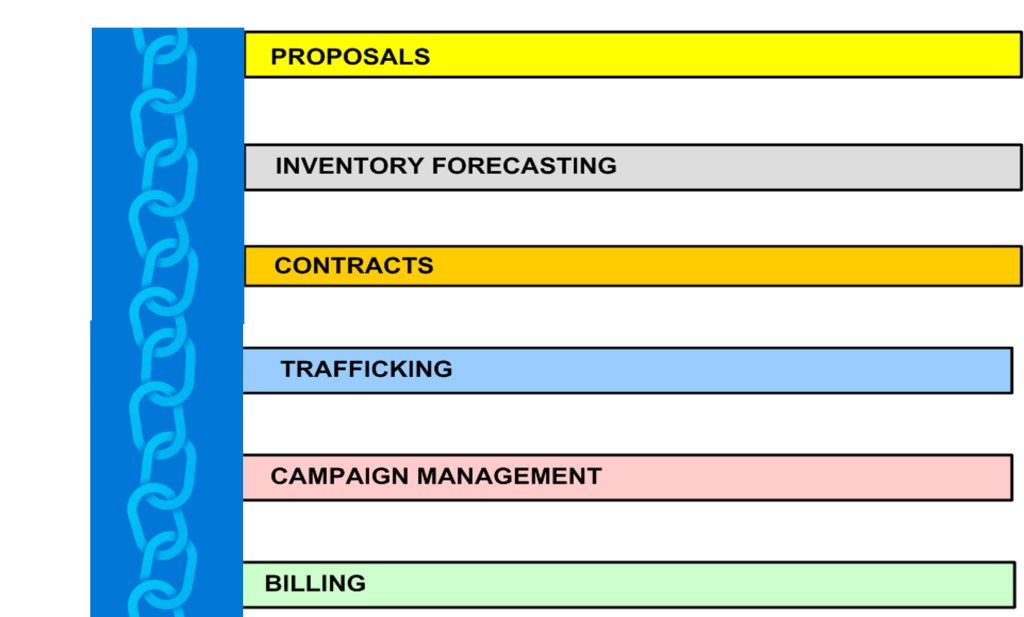
For every process that incorporates AI there is a downstream (or upstream) implication.
It is important for Publishers to consider AI solutions, but context is important.
When considering incorporating AI, either through internal development, or use of an external vendor, or utilizing the existing OMS, there are several questions that need to be answered.
- Will an AI solution decrease the steps required to execute an order, or increase them?
- What are the implications on the rest of the workflow?
- What is the cost in licensing and human capital (i.e. training and maintenance), and will the AI solution be enough to offset that cost?
- Just because you can implement AI into your workflow, should you?
This is the first in a series of discussions on AI in Revenue Operations, starting with the RFP and Proposal stage, followed by analysis of the entire “quote to cash” process.
PART 1: Proposal Workflow
The “Legacy” Proposal Process
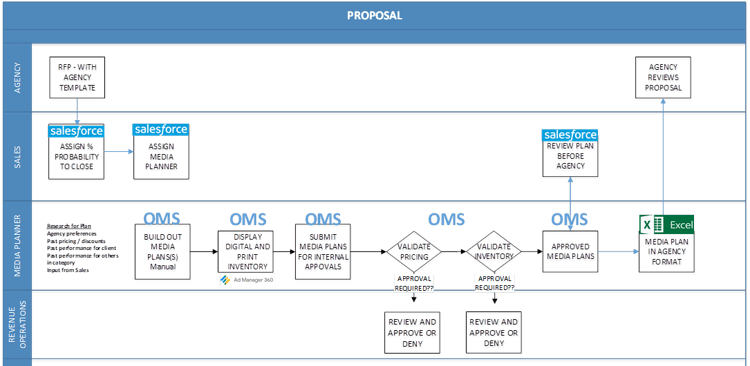
This process begins with an Agency RFP, delivered to the Salesperson, and handed off to the Media Planner (or similar title/function).
The bulk of this work falls on the Media Planner, who must take input from both Agency and Sales, and manually create media plans in response to the RFP. To do this, they need to consider:
- Agency Targeting and Audience Requirements
- Available inventory
- Past pricing / discounts
- Past performance for client
- Past performance for others in category
- Input from Sales
Compounding this manual work is the fact that Media Planning turnover is relatively high, so the institutional knowledge is lost, requiring each new Media Planner to accumulate this data all over again.
Furthermore, the Agency RFP may include a specific template with built in macros which the Planner is required to fill out manually.
The friction in this process is the manual labor required to create and deliver media plans in response to the Agency RFP.
Here’s a graphic representation of how the Proposal Workflow, without AI, works today .
Future Proposal Process – AI Enabled

What can AI do for the publisher to improve the legacy workflow as depicted above?
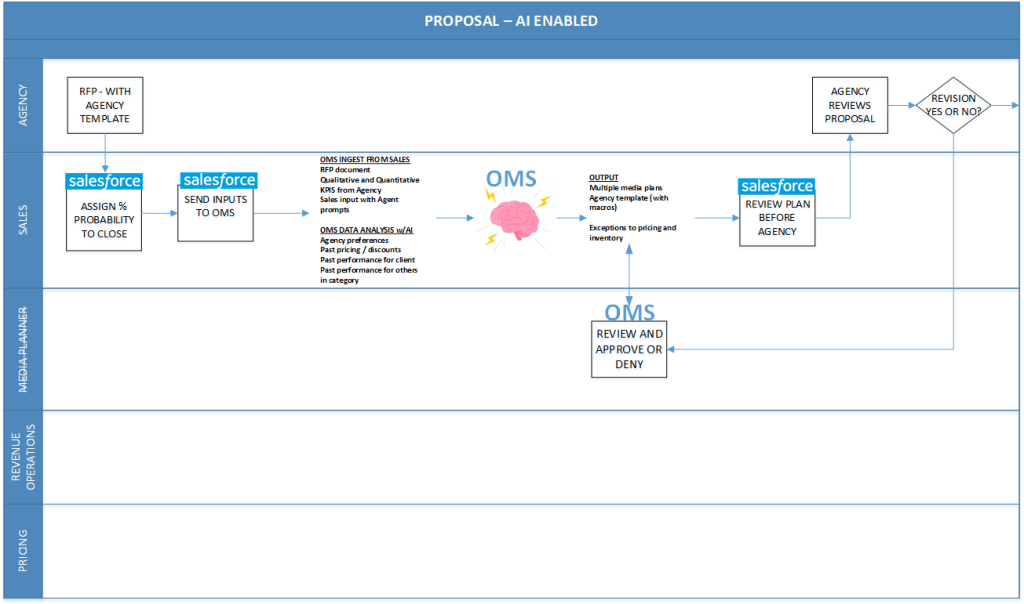
AI can automate all processes from the time the Salesperson receives the RFP, to the time an approved media plan is signed by the Agency, staged in the OMS and ready for trafficking.
Some OMS platforms, as well as stand-alone AI platforms include some, but not all, of the features described in the following pages.
Specifically, we can look for AI to:
Ingest Agency RFP from Sales
- Agency RFP document
- Qualitative and Quantitative KPIs from Agency
- Targeting requirements
- Budget requirements
- Additional data from Sales using AI Agent prompts
Perform Historical Data Analysis to Inform the Agency RFP
- Agency buying patterns and preferences
- Past pricing / discounts
- Past performance for client
- Past performance for others in category
Output the Media Plans
- Multiple media plans if required by Agency
- Routed through internal pricing and inventory checks. (This is standard OMS functionality)
- Automatically revised in response to internal pricing and inventory guidelines.
- Output in the Agency template (complete with macros)
- Sent to Sales and Agency
- AI executes revisions as requested by the Agency and returns to Agency as a revised response to the RFP.
Taking these features into account, here is an example of what a fully featured AI – enabled workflow looks like in support of the Proposal process at the Publisher:
What are the benefits of the AI – enabled approach?
- Dramatic reduction in the LOE and response time required to respond to RFPs and subsequent revisions
- Enable media planners to supervise more Agency relationships, without an increase in internal resources.
Three Potential Scenarios for Implementing AI-enabled Proposal Workflow
There are 3 scenarios for incorporating AI into the proposal process workflow.
Scenario 1:
A new AI proposal building app from a third party is incorporated into the workflow and the Publisher’s ad stack.
- The new app may have been created “from the ground up” to inject AI into the proposal building process, and may be taking advantage of the latest developments in that technology
- The new app will require integration into Salesforce and the existing OMS
- The new app will require implementation, license fees, training and personnel.
Scenario 1 Summary
This is a fast track implementation of AI. But increased fees and a high LOE for integrations and human capital will be required to sustain the application. This may (or may not) be offset by the reduced workload for media planners.
Scenario 2:
AI functionality for proposal workflow is built into the existing OMS.
- The OMS includes AI functionality for proposal workflow
- Integrations with Salesforce (or other CRM) remain intact.
- Marginal (if any) increase in fees, training and personnel
- OMS adoption of AI brings the Publisher into the AI space, in a modulated fashion – which separates what is critical from a feature standpoint from what may be unwanted “noise”
- The AI solution offered by the OMS may be just one of many features that need to be supported and may (or may not) keep up with AI centric proposal workflow application.
Scenario 2 Summary
A more modulated approach to AI adoption. AI development by the OMS will be interwoven with other features in the platform, and more likely to take into consideration the entire end to end workflow. Plus, lower LOE for the Publisher.
Scenario 3:
Internal Publisher Development is used to Incorporate AI into the Proposal Workflow.
A classic build-versus buy scenario.
- Publisher can create bespoke AI solutions for automating proposal workflow
- Out of pocket costs are internal resources
- This is a “heavy lift” in terms of LOE, which must be supported for years by dedicated, internal publisher resources.
- Historically, internal development teams are difficult to maintain and may not be nimble enough to stay abreast of industry changes in media.
- Calls into question if the core business of the Publisher is software development, or content.
- Out of pocket costs are internal resources
Scenario 3 Summary
The “build” scenario for AI – enabled proposal workflow requires a huge, lengthy commitment in time and internal resources
Summary
Publishers will eventually be adopting some degree of AI to improve proposal workflow.
Revenue Operations should take a proactive lead in defining how AI will be incorporated into workflow.
The options for engaging resources to onboard AI include leveraging your existing OMS, engage with a new third party AI platform, or developing an AI platform in-house.
The decision points for adopting AI for Publishers include the following:
- Net reduction of workflow steps, and avoiding breakage upstream or down
- Total cost of ownership (license + integration + human capital)
- Integration with CRM, OMS, GAM, and programmatic platforms
- Governance + compliance requirements
- Impact on staffing and roles
Part II on this discussion will explore how the Inventory forecasting and management process can be enhanced through AI. Coming Soon!
Regards, Doug Wintz

 DMW MediaBlog